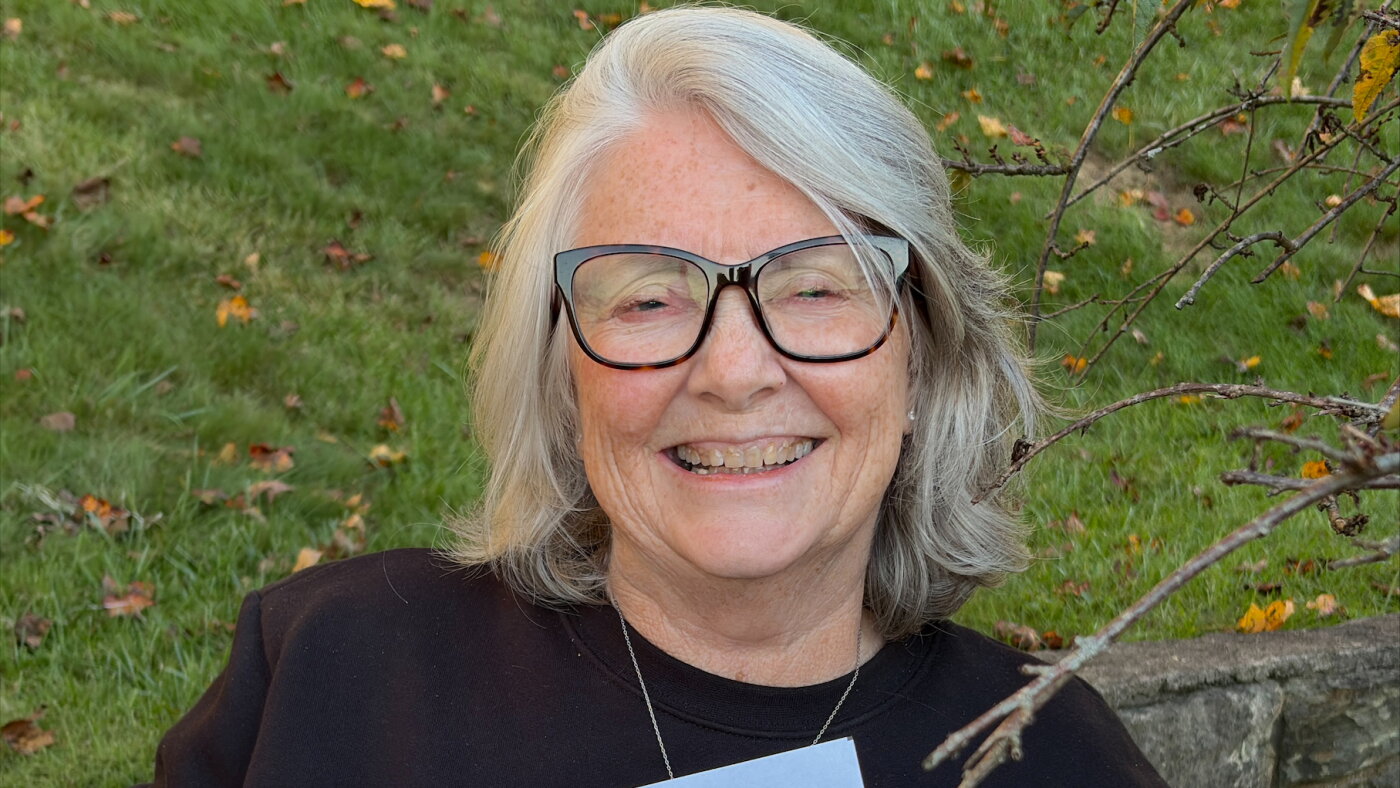
Katie Zacharia prepares to explain that what you saw, what you heard, and what Trump posted at 3am are all being taken totally out of context.
The White House has reportedly offered the press secretary job to Katie Zacharia, a conservative commentator whose main qualification appears to be already getting paid to spin for Trump at his own media company. Why bother with the illusion of separation between the presidency and Trump Media & Technology Group when you can just hire directly from the in-house propaganda shop? Regulatory firewall? That’s for countries that aren’t run like a family brand extension.
Zacharia would be Trump’s sixth press secretary across his two administrations, because nothing screams stable governance like burning through spokespeople faster than Truth Social burns through cash. Her résumé includes a blink-and-you-missed-it stint at the Department of Homeland Security from February to March, which is either the shortest federal service or the fastest realization that basic governance is wildly incompatible with this White House.
Karoline Leavitt, the last press secretary, has apparently completed the traditional lifecycle of a Republican comms hack: White House podium to Fox News contributor, like a larva becoming a moth that only flies toward the brightest camera light. Zacharia, a frequent conservative media guest, now gets promoted from defending Trump World on TV to defending Trump World from the actual podium, where she’ll help manage the administration’s relationship with the press—also known as coordinating daily attacks on journalists while refusing to answer basic questions.
The job is described as “complex,” involving coordination across the White House and handling a flood of inquiries. Realistically, it’s coordinating which conspiracy theory, legal threat, or grievance goes out first, and deciding whether today’s official talking point will be posted on Truth Social before or after it’s read from the lectern. The line between government communications and Trump’s private media hustle wasn’t just blurred; they’ve handed it a badge, a podium, and a press credential.
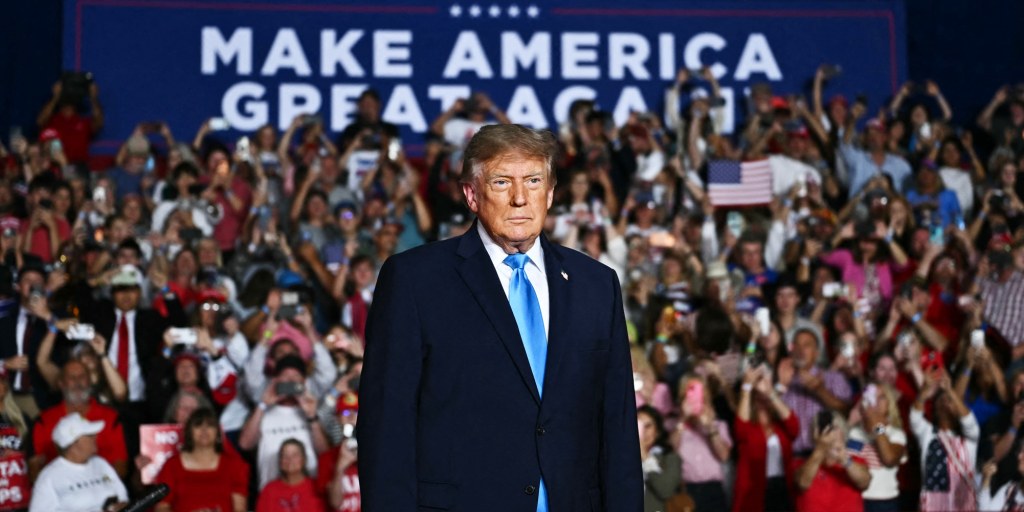
Trump doing his little stage dance, presumably celebrating the part where you unknowingly picked up the tab for his campaign ads.
Donald Trump looked at a federal law that literally says "No part of any appropriation... shall be used... for publicity or propaganda" and apparently read it as a how‑to manual. A $20 million Department of Homeland Security appropriation has been repackaged into glossy, campaign-style TV spots featuring Trump promising to "protect us from communism," showing off the border wall, and vowing to "liberate America" from unnamed "villains" and "warmongers"—all lovingly tagged, like a confession, "Paid for by the U.S. Government."
Republicans in Congress wrote and passed the very appropriations bill that bans this kind of domestic propaganda, Trump signed it, and then he personally ordered the ads anyway, because of course he did. Watchdogs like Common Cause and now the DNC are suing, pointing out that these are obviously campaign ads, even if they don’t say "Vote Trump" in Comic Sans. Meanwhile, Trump—sitting on a super PAC war chest of up to $415 million that he calls "my money that I control"—has generously offered that his PAC will pay for future ads, but not the roughly $12 million already burned through your tax dollars.
Ethics experts note that the government is "not supposed" to run political propaganda with public funds, which is adorable, because the oversight mechanism they’re counting on is Congress, the same people who handed Trump the DHS money he’s now using as a personal re-election subsidy. From the guy who used his "charity" to settle lawsuits and had to cough up $2 million for foundation abuses, we’ve now arrived at the logical sequel: why grift donors when you can just bill the entire country? Your money, his ads, and a federal law treated as a suggestion box.
Donald Trump gestures confidently while promising $2 gas and 2% mortgages, as if reality is just another line item he can default on.
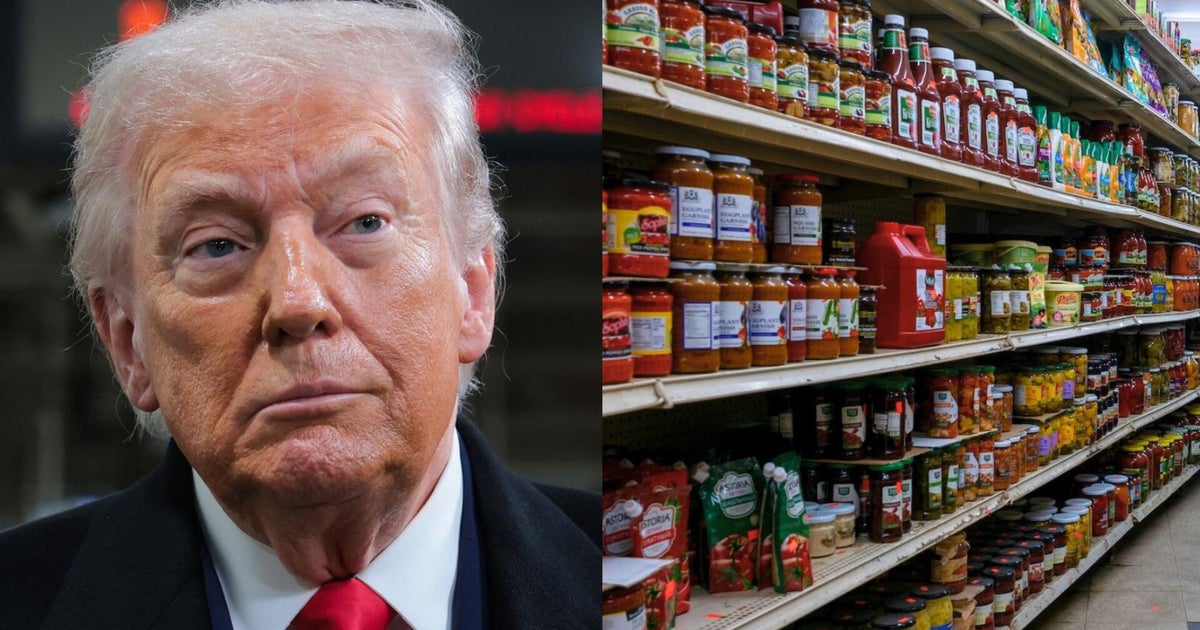
Donald Trump ran in 2024 on the "Everything Will Be Cheaper, Trust Me" platform, promising $2 gas, 2% mortgages, and grocery bills that wouldn’t require a GoFundMe. Two years later, the data says Americans did get something: higher prices on pretty much every basic necessity, supercharged by his own policies. Groceries are up another 4% since his "vote for me, food gets cheaper" pitch, on top of the 23% pandemic-era spike. The supermarket is now less a store and more a recurring trauma response.
Not content with tariff-driven inflation, Trump decided to attack Iran in February, helping to blow up oil markets along with regional stability. Gas is now averaging $4.37 a gallon, up 47% since the day before the war, and diesel is loitering menacingly above $6.25, quietly jacking up the price of moving literally anything anywhere. Meanwhile, electricity bills are climbing as utilities and data centers suck up more power, while the White House communications office insists the president has delivered "tangible wins" and "stopped Biden's inflation crisis." Sure: if you squint hard enough, you can almost mistake spiraling costs and tariff-fueled inflation for a working-class tax cut.
Economists politely note that Trump’s tariffs alone added roughly 2.9 percentage points to inflation, and that the Iran adventure dumped another load of gasoline on the economic bonfire. The administration, on the other hand, is out here bragging about "economic wins" as voters stare at their grocery receipts like they’re reading a ransom note. Trump promised to make life cheaper. He did — for oil companies, defense contractors, and whoever’s betting on inflation. For everyone else, welcome to the premium, deluxe, gold-plated MAGA Cost of Living Experience.
Artist’s rendering of congressional oversight: a tiny gavel trying to swat away a $400m Qatari jet, three crypto coins, and Jared Kushner’s term sheet.
Democrats are helpfully publishing their future to-do list for when – or if – they take back the House and Senate, and it’s basically: clean up the Trump crime scene the GOP has been living in like it’s normal. Jamie Raskin is again demanding Jared Kushner explain how he went from “informal foreign policy adviser” to “guy who gets $2bn from the Saudi sovereign wealth fund” without it being, you know, grotesque self-dealing. Also on deck: that cute little $400m plane Qatar handed Trump, a Trump Jr wedding bash subsidized by a Russian oligarch, and a grab bag of defense contracts that somehow keep landing in the extended Trump family’s laps like very expensive, very coincidental pigeons.
The crown jewel is the IRS settlement, where Trump sued the IRS for $10bn and the DOJ responded by basically writing “do not touch” on his tax returns. The settlement bars audits of Trump, his family, and related companies – because why wouldn’t the president get bespoke immunity from the taxman? Democrats in both chambers want documents on how this miracle of legal innovation happened, which officials signed off, and which corporations are now planning to treat the Trump deal as their own personal get-out-of-audit-free card. A federal judge has already hinted this arrangement conflicts with federal law, which is probably why nobody in the administration wants to answer Ron Wyden’s basic yes-or-no questions.
Then there’s the crypto carnival. Richard Blumenthal and Elizabeth Warren are chasing the $Trump meme coin and World Liberty Financial, trying to map who actually owns what in this swamp of tokens, shell companies, and foreign funds. Disclosures suggest Trump has pulled in more than $1.2bn from crypto ventures, including roughly $588m tied to World Liberty token sales, while Maxine Waters is floating legislation to claw back his “ill-gotten gains” – a phrase doing Olympic-level understatement here. Add in Trump Jr’s cozy role as “strategic advisor” to betting markets Kalshi and Polymarket, some very convenient trades around the Iran war, and suddenly even Republicans like Senator John Curtis and Oversight Chair James Comer are pretending they’ve discovered the concept of insider trading.
Hovering over all of this is the Epstein document fiasco, where the DOJ managed to miss deadlines, under-produce millions of pages, over-redact, and also accidentally expose victims’ names – a performance so bad it united Ro Khanna, Thomas Massie, and a lawsuit from journalist Katie Phang. If Democrats get the gavels, they’re promising to test whether Congress still has the ability – or the spine – to drag this administration’s grifts, sweetheart deals, and crypto side hustles into the light. Hakeem Jeffries says they’ll “hold the crooks accountable”; the real suspense is whether the crooks are more afraid of subpoenas than they are of losing their next Dubai coin offering.
The White House has discovered a bold new frontier in branding: your children. Millions of American kids are being auto-enrolled into government-created "Trump Accounts," because nothing says "responsible public policy" like turning the federal government into a marketing arm for the sitting president’s personal brand. Surrounded by administration officials, business leaders, and Ted Cruz — nature’s reminder that shame is optional — Trump bragged that these accounts will help children "build wealth," as long as everything goes just right for the next few decades. So, no red flags there at all.
This isn’t just a savings plan; it’s a taxpayer-backed loyalty program. The state sets up investment accounts, slaps the president’s name on them, and quietly normalizes the idea that your financial future should be tied to a politician’s personal brand like it’s a casino rewards card. Public infrastructure is now a Trump product line, and kids are the captive customer base. You don’t opt in; the government does it for you, and if you ever wondered what soft authoritarianism looks like in spreadsheet form, it’s auto-enrollment into a presidential vanity fund.
The whole thing is being sold as a gift to the next generation, but the real asset here isn’t the kids’ balances — it’s the data, the dependence, and the narrative that Trump personally "gave" your children money. That’s not policy; that’s a long-term campaign contribution disguised as a college fund. Imagine Social Security, but rebranded as "Trump Security" and run like a rewards app, and you’re very much on the road we’re on. The oligarchs get fee streams and political capital, the president gets his name etched into another piece of the state, and your kid gets to grow up inside a financial product that doubles as a cult souvenir.
Artist’s rendering of Trump personally signing away $90 at a time to Democratic campaigns while insisting this is a brilliant political strategy.
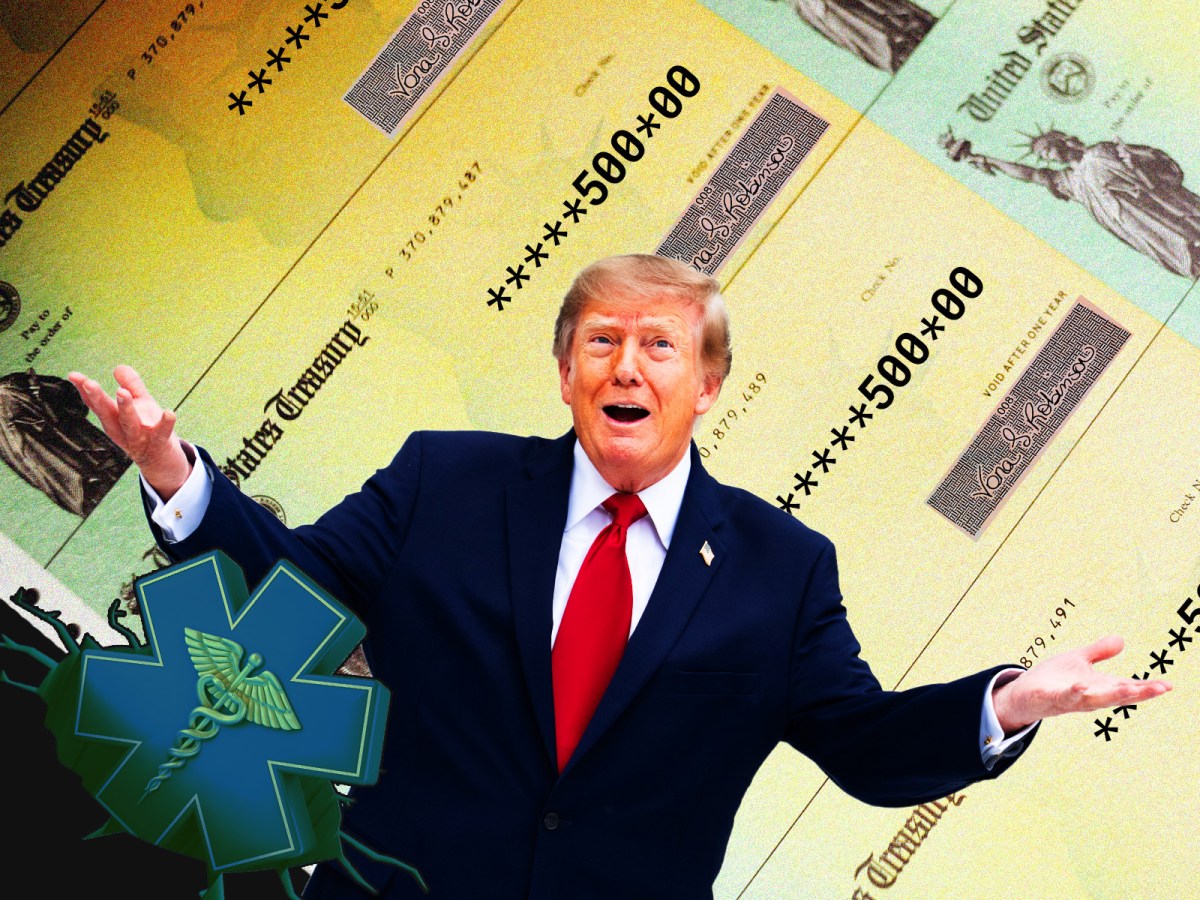
Trump, having spent years taking a chainsaw to the U.S. healthcare system, is now mailing out pre-midterm "healthcare" checks so small they barely cover an urgent care co-pay, but just big enough to function as a taxpayer-funded campaign flyer. One of the schemes is already flagged by experts as "legally dubious," which in Trump-world is basically the Good Housekeeping Seal of Approval.
Unfortunately for the Dear Leader, Americans have decided that if they're going to be handed a tiny slice of their own money as an election-season bribe, they might as well weaponize it. People are gleefully funneling their $90 "thanks for not dying yet" payments to refugee support organizations, homelessness services, mutual aid for a trans woman, and every flavor of Democrat they can find on ActBlue. Trump tried to buy goodwill and instead ended up subsidizing Roy Cooper, Janelle Stelson, Adam Hamilton, and groups building Democratic majorities in red-state legislatures.
So the grand plan to erase two years of healthcare vandalism with a handful of government-funded campaign leaflets is backfiring beautifully: the more checks he sends, the more money flows to the very people working to end his party’s power. It’s like a reverse Citizens United, except the dark money is just Trump setting his own political future on fire, $90 at a time.
Former Trump voters stare into the middle distance as they realize the guy who ran the country like a merch store did not, in fact, fix their lives.
After a decade of Trump treating the presidency like a reality show with nuclear codes, the New York Times finds a shocking new development: some Republican voters have finally located the "off" button. Working-class voters who once treated Trump like a golden ticket out of the status quo are now looking at sky-high fuel prices, endless culture-war theatrics, and the general clown car of MAGA politics and concluding that, no, actually, this is not the winning lifestyle they were promised.
We meet people like Jim Pasek, 80, who once loved Trump but now thinks "he's not making sense" — which is adorable, because that implies there was a coherent phase somewhere between "build the wall" and "inject bleach." Younger voters like Sebastian Covey are literally downsizing their vehicles to survive gas prices while the GOP keeps offering them more Trump, more grievance, and absolutely no plan that isn’t tax cuts and vibes.
Polls show only 29 percent of likely Republican voters now think the economy is better than a year ago, down from 72 percent in January, which political analyst Charlie Cook dubs the "red undertow" — that magical place where Republicans are too disgusted to vote Democrat but just disillusioned enough to stay home and let the chaos team underperform. Activists like Lindsay Kronemeyer, who once canvassed for Trump, now say he’s not part of the party’s future. Translation: the movement that forgave kids in cages, attempted coups, and a pandemic body count is finally getting bored because their wallets and gas tanks are empty.
So no, this isn’t a moral awakening. It’s not accountability. It’s just the logical endpoint of a decade of forever-grifting where the marks finally notice the wallet missing — and maybe, just maybe, decide four more years of Trump-world fan fiction isn’t worth another tank of $6 gas.
Trump proudly holding up a $90 Medicare "improvement" check like he just cured cancer instead of looting the couch cushions of the healthcare system for campaign swag.
The Trump White House has discovered a bold new innovation in health policy: spend two years taking a chainsaw to Medicaid and the ACA, then a few weeks before the midterms, mail people checks and hope they get amnesia. Seniors on Medicare Part B are supposed to receive a one-time "nearly" $100 payment, while some ACA enrollees get a $500 consolation prize for the privilege of watching their premiums spike after Republicans killed enhanced tax credits and gutted coverage in their "One Big Beautiful Bill" austerity fiesta.
Legally, the money is coming from the Medicare Improvement Fund, which Congress created to, stay with me here, improve Medicare. Trump and Russ Vought have decided that "improvement" now means "election-year cash-back rewards program". Experts politely call this "legally questionable" — Washington-speak for this is not what the statute says, but good luck finding a prosecutor while the perpetrators run the executive branch. Even former budget officials are pointing out that cutting everyone a $90 check is not a health system reform, it’s a coupon.
Meanwhile, the actual policy backdrop is a bonfire: hundreds of billions slashed from Medicaid, new work requirements and red-tape hurdles for low-income adults, research grants axed, access to care restricted, and ACA premiums jumping an average of 58% after Republicans let enhanced subsidies die. But sure, here’s a one-time check that might cover an extra tank of gas or part of a copay. The administration calls it making Medicare more affordable; everyone else calls it what it is: a taxpayer-funded campaign flyer with routing numbers.
The Trump administration has decided that what the Russia-Ukraine war really needs is less professional diplomacy and more Jared Kushner. Jared and fellow Trump-world developer Steve Witkoff are flying Ukrainian negotiators and European officials to Miami, presumably so they can workshop "new ideas" for peace somewhere between the beach and the donor suite. Official diplomats still exist, but they're now basically the IT help desk for whatever real-estate-brained "peace initiative" the family comes up with.
Instead of empowering career negotiators, Trump, Marco Rubio and friends are outsourcing war-and-peace to the guy whose previous Middle East plan was a glossy brochure stapled to a real estate prospectus, plus a developer whose primary qualification appears to be "knows Trump". With midterms looming and winter approaching, the White House is frantically hunting for a headline ceasefire on energy and grain that Moscow hasn't agreed to, while dangling talk of sanctions relief and "post-war prosperity" like it's a VIP investor deck. Ukraine, Europe, NATO, and the EU are invited to this Miami peace pageant, but the real audience is U.S. voters and whatever oligarchs are waiting at the other end of the sanctions pipeline.
The cherry on top: Kushner and Witkoff may pop back over to Moscow later this month to chat with Putin directly, because what could possibly go wrong when private dealmakers with opaque foreign financial ties run an off-the-books shadow State Department from a beach resort? It's not diplomacy; it's forever-grifting with nukes in the background.
Trump gives Elon Musk a science medal for spending $300 million proving that in America, peer review has been replaced by wire transfers.
Trump held a "Science: A New Golden Age" summit, which is a bold name for an event where you brag about American genius while systematically starving actual science agencies. He rolled out the Genesis Mission—an AI-powered scheme to "accelerate" research in energy dominance and national security—funded not by restoring gutted federal budgets for things like chronic disease and climate research, but by $2.4 billion in computing power from a who’s-who of surveillance capital: OpenAI, Anthropic, Elon Musk’s xAI, Palantir, and Amazon.
Then came the awards ceremony, because nothing screams scientific rigor like a donor appreciation banquet dressed up as the National Medal of Science. Elon Musk (Trump’s nearly $300 million superfan), Sergey Brin, Nvidia’s Jensen Huang, AMD’s Lisa Su, Satya Nadella, and Michael Dell all walked away with medals. Every single one is either a major Trump donor, Republican benefactor, or has written seven-figure checks for Trump’s inauguration, his ballroom, or his latest branding exercise, the "Trump Accounts" for kids. Meanwhile, Trump’s own financial disclosures show he’s been trading stock in Nvidia, Microsoft, Alphabet, Tesla, AMD, and Dell.
So the plan is clear: defund independent public science, then hand the keys to research and national priorities to a cartel of tech billionaires who bankroll your campaigns and decorate your balance sheet. Call it a "new golden age" and hope nobody notices that the gold is being strip-mined out of NIH budgets and laundered through AI buzzwords and medal photo-ops. Science policy by portfolio management—what could possibly go wrong?
RFK Jr. and Trump promise to battle Big Chemical while standing in front of a giant, flashing "Sponsored by Big Chemical" sign.
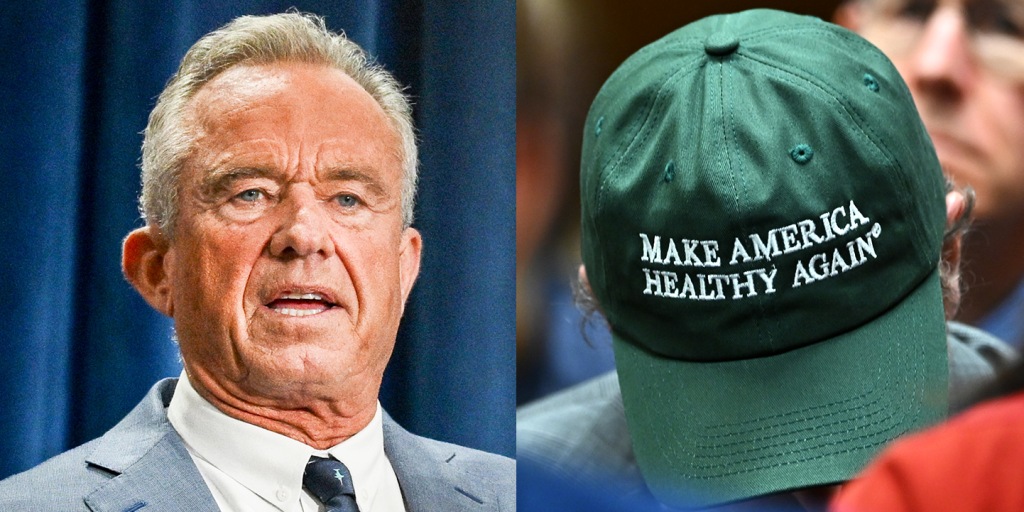
The Make America Healthy Again crowd is waking up to the shocking revelation that the administration led by a lifelong branding addict and a Kennedy scion with a conspiracy podcast may not be the vanguard of evidence-based public health. A new MAHA scorecard from former RFK Jr. insiders says the Trump administration has broken more than 85% of its promises on food, agriculture, and environmental health, while shoveling favors at the chemical industry: approving new pesticides, hiring industry lobbyists, and boosting supplies of glyphosate, the weed killer MAHA literally organized against.
What began as a weird coalition of organic-moms, anti-vaxx cranks, and "drain the corporate swamp" Trump voters has now split into open warfare. Activists accuse Trump and RFK Jr. of selling them out while the White House issues press releases about "historic" MAHA victories and "regenerative farming" like a Goop catalog written by Monsanto. Meanwhile, the EPA is weakening mercury standards, rolling back PFAS drinking water limits, and keeping mRNA vaccines and ultra-processed foods in play, while Kennedy clings to his "science, transparency, and accountability" branding as his own supporters publish a receipts-filled betrayal report.
The funniest part is that many MAHA leaders still insist they "know where [Kennedy’s] heart lies" — as if the heart matters when the policy is busy doing shots with pesticide manufacturers. The movement that set out to purge toxins from America instead got a masterclass in regulatory capture: Trump gets the headlines, corporations get the deregulation, and MAHA gets a nicely formatted PDF explaining how thoroughly they were played.
Kimberly Guilfoyle, currently serving as U.S. Ambassador to Greece and eternally serving as Ambassador to the Grift, reportedly hit up a Trump donor for a cool $100,000 to pay her American Express bill days before her confirmation hearing. According to the Wall Street Journal, she told GOP donor Eric Deters, “You could just send it here. It won’t show up anywhere if you wire money to American Express,” which is the kind of sentence you usually hear right before a compliance officer faints.
Because nothing screams "public service" like a federal official trying to route six figures of donor cash straight into her credit card account while she’s about to sit before the Senate and swear she’ll uphold ethics rules. The alleged pitch wasn’t "support diplomacy" or "advance U.S. interests" — it was pay my AmEx, but make it untraceable. That’s not campaign finance, that’s "Venmo me but for oligarchs."
The Trump orbit has long treated government like a rewards program, and Guilfoyle apparently decided to cut out the middleman and just swipe the card directly. Why bother with PACs, dark money groups, and shell LLCs when you can just tell a donor, with breathtaking honesty, that the money "won’t show up anywhere" if funneled through a credit card company? It’s ethics-by-loophole, starring an ambassador who seems to think the Foreign Corrupt Practices Act is a travel brochure.
And of course, this all happened right before her confirmation hearing, while senators pretended to vet her for conflicts of interest. Mission accomplished: the only thing really vetted was whether American Express could handle being the unofficial bank of Trumpworld’s side hustles. State Department diplomacy has apparently been replaced with points, miles, and quiet six-figure wires.
Trump congratulates CFTC Chair Michael Selig for successfully turning a federal regulator into a suggestion box for crypto billionaires.
While hundreds of billions slosh through crypto and prediction markets every week, the Trump administration has thoughtfully responded by taking the Commodity Futures Trading Commission out behind the shed and removing 21% of its staff. Enforcement actions didn’t just dip; they fell off a cliff — nearly an 80% drop in 2025 compared to the previous decade. Truly a bold new era of “law and order,” where the only laws enforced are gravity and the invisible hand picking your pocket.
The CFTC’s ex-enforcement lawyers say the quiet part out loud: after Trump’s 2024 win, people who brought fraud cases against crypto darlings like Gemini, Voyager, Celsius, FTX, and Polymarket were “punished” and pushed out. Acting chair Caroline Pham reportedly ordered all crypto cases closed, then promptly exited government and landed a cushy job as chief legal and administrative officer at MoonPay — a crypto company. Regulatory capture isn’t a bug here; it’s the business model.
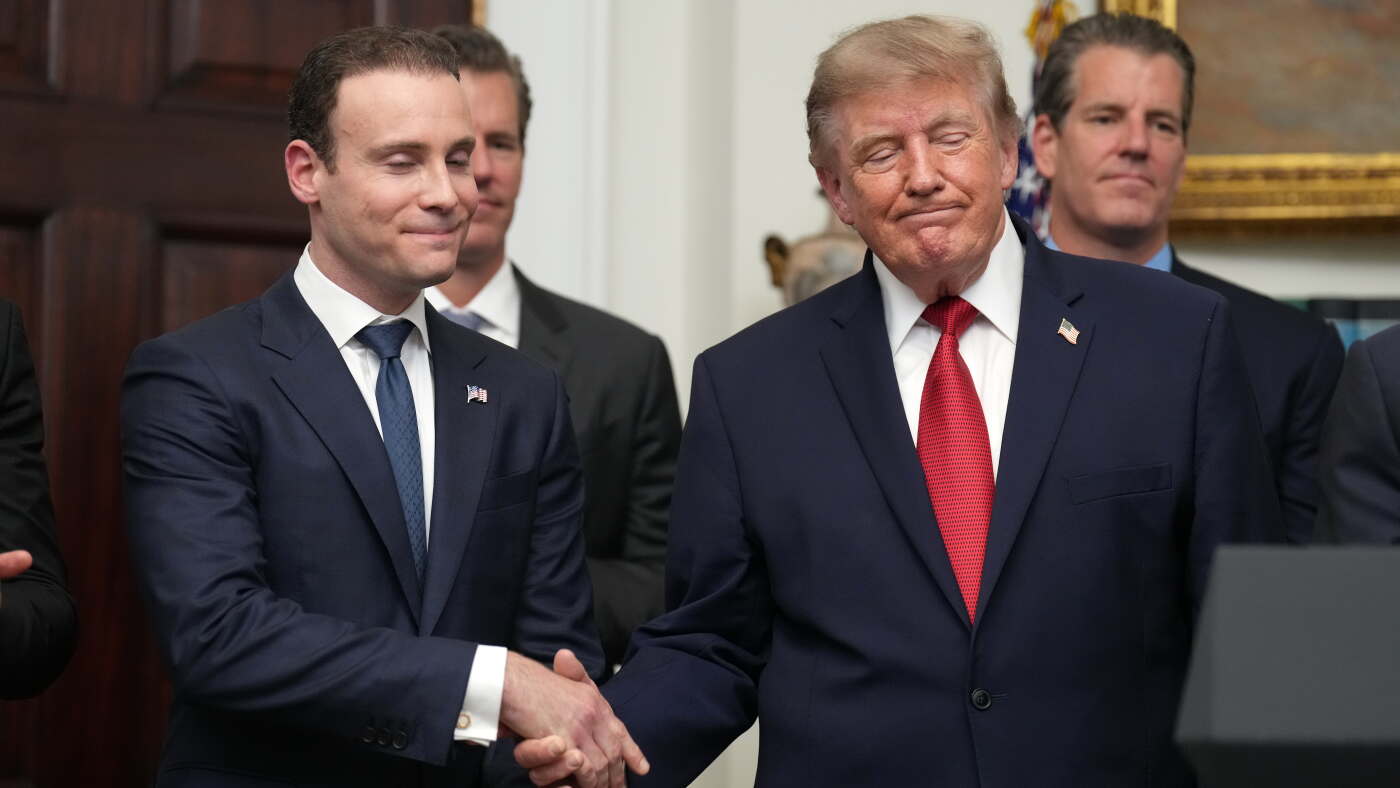
Current chairman Michael Selig, pictured beaming and handshaking with Trump, is praised by the agency for promoting “integrity and responsible innovation,” which is an adorable way of saying: we fired the cops, shredded the case files, and told the casino owners to grade their own homework. The message from Trump’s Washington is clear: if your scam is big enough, don’t worry about the regulator — it’s already been downsized.
Trump, en route to Texas to endorse the concept of consequences-optional law enforcement.
Donald Trump is heading back to Texas yet again, this time to stump for state Attorney General Ken Paxton, a man whose legal problems have more sequels than the Fast & Furious franchise. Paxton, fresh off an impeachment scare and a career spent treating the law like a loose suggestion, is apparently the perfect mascot for a movement that sees criminal exposure as a campaign credential. Trump worrying about Texas while clinging to Paxton is less a show of strength and more a support group for guys who think indictments are just fancy press releases.
Meanwhile, CBS packages it all neatly between segments on Iranian attacks on a U.S. base and midterm horse-race chatter, because nothing says "totally normal democracy" like a former president barnstorming the country to rescue one of the most ethically radioactive officials in the GOP. The through-line is simple: as long as you’re loyal to Trump, corruption is a résumé builder, not a problem. Accountability is for suckers; impunity gets you a rally.
Donald Trump beams from a taxpayer-funded TV ad, reminding Americans to love their country, especially the part of it that pays his production costs.
The Trump White House has apparently decided that if you’re going to run state propaganda, you might as well put it on prime-time TV and send the bill straight to the people you’re gaslighting. The DNC is suing the administration over glossy, taxpayer-funded ads that paint Donald Trump as America’s heroic savior in a "final battle" — ads that were paid for with funds Congress earmarked for Customs and Border Protection, not for a 30-second personality cult highlight reel.
To make it extra on-brand, Trump is being sued under a law he signed that bans federal funds from being used for domestic "publicity or propaganda" without congressional approval, plus the Anti-Deficiency Act and the Purpose Statute. So the president who can’t stop screaming about the “weaponization of government” is literally accused of weaponizing DHS money to subsidize his campaign messaging. CBP leadership was reportedly cut out of the decision, because why let the border agency weigh in on whether its budget should be repurposed into a Fox News sizzle reel?
After the blowback, Trump bravely retreated on Truth Social, announcing that he and his PAC will totally pay for the ads going forward — maybe, possibly, at some undefined point in the multiverse. Meanwhile, the spots are still airing with disclaimers that they’re paid for by the U.S. government, and the White House won’t say whether those buys happened before or after his big "never mind". At least $10 million has already been spent from a $20 million federal contract, but reimbursement is apparently a mystery best left to faith and vibes.
FCC Chair and Trump appointee Brendan Carr helpfully declared that government-funded personality cult ads "don’t raise red flags" and are "not out of the ordinary" — which is true if your ordinary reference point is, say, Viktor Orbán. The White House insists the spots are "clearly not political" and just remind Americans to "love their country," which is a bold way of describing campaign-style hero worship funded with money meant for border security. Authoritarian aesthetics, grift financing, and legal booby traps signed by Trump himself: the propaganda state continues to write its own parody.
Artist’s rendering of Camp David 2.0: same nuclear codes, 30% more resort fees.
Trump has apparently decided that if he can’t live forever, his golf courses should. The latest scheme: turn his West Palm Beach golf club into a new Camp David-style permanent presidential retreat. Not by donating the whole thing to the government, of course—don’t be ridiculous—but by carving out a little slice of land on his private club so future presidents can have their own taxpayer-adjacent bungalow at Trump International Golf Club.
The pitch, delivered by the club’s lawyer to Palm Beach County officials, comes with a very serious statesmanlike perk: future presidents will be offered free memberships to Trump’s club. So the presidency, already thoroughly converted into a VIP rewards program during his first term, now comes with a built-in loyalty card for whatever Trump-branded property he’s trying to keep afloat. Instead of Camp David as a secure, government-owned retreat, we get Camp Donald: a presidential crash pad wrapped in a perpetual conflict of interest, where every tee time is another advertisement for the guy who treated the Oval Office like a pop-up shop.
This is the distilled essence of the second Trump term: wars, authoritarian drift, trade chaos, and in the middle of it all, an octogenarian real-estate hustler frantically stapling his name to federal functions so the government can’t stop advertising his brand once he’s gone. It’s not public service; it’s an estate-planning strategy with nukes.
Woman holds a letter from Trump explaining her $500 "health care help" — roughly the cost of one week of the premium hike his policies helped create. Very cool coupon, though.
The Trump administration has discovered a bold new health care strategy: blow up Affordable Care Act subsidies, watch premiums skyrocket, then mail out a one-time $500 check and a glossy presidential letter like it's a Publishers Clearing House consolation prize. Ellen Allen, a 63-year-old West Virginian who drained retirement savings to pay nearly $2,000 a month for ACA coverage until she hit Medicare at 65, opened her Treasury envelope and accurately identified it as what it is: a "political stunt."
This is not subtle. The $500 checks are surgically targeted to people in the 30 states that use Healthcare.gov who make just enough to lose subsidies but not enough to shrug off a $2,000 monthly bill — a demographic also known as "likely to be furious right before the midterms." On top of that, Trump is sending $90 Medicare "improvement" checks to 20 million seniors, a number chosen presumably because $90 is just enough to mention in a campaign ad and nowhere near enough to cover anything more serious than a co-pay and a sad pharmacy snack. As Allen points out, if the White House wanted to do something meaningful, it could make health care affordable year-round instead of tossing out election-season coupons and calling it reform.
So instead of fixing the policy choices that jacked up premiums, the administration is raiding the couch cushions, cutting tiny checks, and stapling Trump's name to them like a campaign mailer paid for by you. Actual structural health care reform? No time for that — there's a midterm to lose.
TrumpRx: like a GoodRx coupon, if the coupon also claimed to have single-handedly solved global drug pricing.
Donald Trump has once again discovered that if you just say "lowest drug prices in the world" enough times, someone will eventually check the math. KFF did, and the results for TrumpRx — the White House–branded drug discount program — are less "historic breakthrough" and more "Walgreens clearance bin." Of 32 brand-name drugs with no generic competition, TrumpRx was cheaper than other wealthy countries on 17, more expensive on 15, and actually the lowest in the world on a grand total of five. Meanwhile, Trump’s miracle discount site manages to offer Enbrel at $3,354 a month — over five times the average price abroad — which is a bold interpretation of the word "deal."
This whole circus is supposedly powered by Trump’s "most favored nation" arrangements, in which drugmakers get tariff relief in exchange for giving Americans the same prices they offer other countries. Except the prices are wildly inconsistent, the contracts are secret, and the administration won’t release details. Instead of using Medicare’s negotiating power like Biden’s reforms, Trump has built a coupon website that mostly routes people to manufacturer programs, doesn’t count toward deductibles or copays, and cherry-picks drugs where companies feel like playing ball. Health experts politely call it a "mixed bag"; a more accurate description is state-sponsored marketing campaign with a side of policy cosplay.
The best part: Trump is already boasting that his team has secured discounts of "60, 70, 80 and even 90%" from 26 pharma giants, while the real-world analysis shows… sometimes lower, sometimes higher, frequently worst in class. And because everything is done through opaque one-off deals, there’s a very real risk that the "solution" to high U.S. prices just means jacking up prices abroad so the numbers look closer — a global race to the top of the price-gouging ladder. America didn’t get the lowest drug prices in the world; it got a campaign-branded pharmacy portal and a fresh reminder that under Trump, health policy is mostly a backdrop for the merchandise table.
Ken Paxton, Texas’s indicted Attorney General and Trump’s favorite legal arsonist, quietly told donors that his Senate campaign is getting kneecapped by the Iran war and gas prices, moaning, “I don’t make the decisions” like a man who just realized hitching his entire career to President Drone Strike might have some downside. In a closed-door D.C. fundraiser — because nothing says "Texas grassroots" like whining to lobbyists in Washington — Paxton admitted that $6 diesel, sky-high food prices, and general economic misery are "by far our biggest problem" and the reason his numbers are tanking.
Publicly, of course, the campaign insists this is a "non-story" and that Trump is "doing everything he can" to lower prices, which is an interesting spin given Paxton is privately blaming Trump’s war and Trump’s economy for his electoral faceplant. He even conceded that Trump’s midterm convention in Dallas "dropped our numbers" and that the campaign is being run from D.C., a fun confession from the guy who brands himself as the fearless Texas fighter against coastal elites while taking orders from them.
Paxton’s big solution to the chaos his own team helped create? Some tax-cut doodles — housing and health care write-offs plus a juiced child tax credit — that he swears will patch over the geopolitical oil fire his party keeps feeding. He can’t stop the war, he can’t control gas prices, and he says he doesn’t even know what’s behind some of the decisions. But he’d very much like a promotion to the U.S. Senate so he can keep cheering on the people actually making those decisions. Truly, the accountability era.
John James carefully measuring the exact millimeters of 'daylight' he needs between himself and Trump while still cashing the endorsement check.
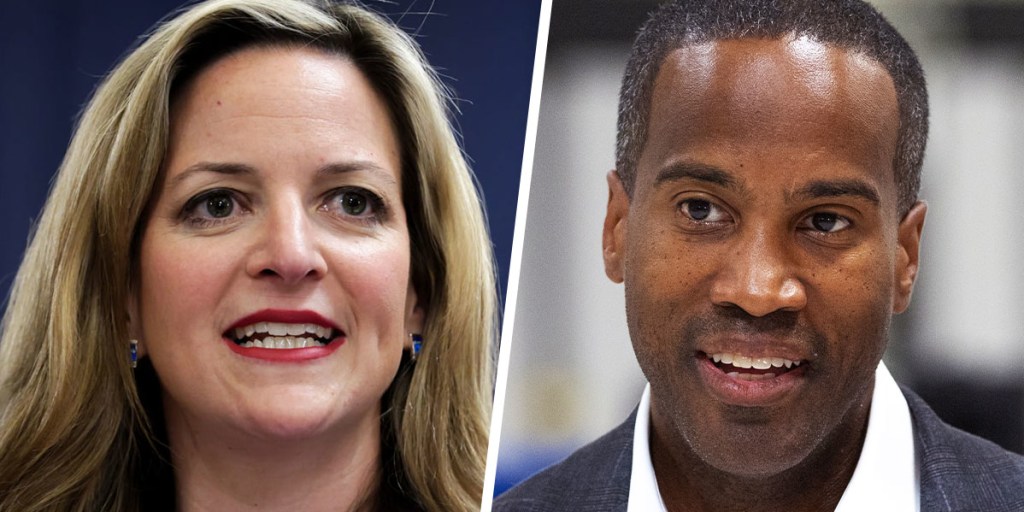
John James, who happily rode Donald Trump’s endorsement through the Michigan GOP primary, has now discovered the ancient political art of pretending not to know the guy. Onstage with Democrat Jocelyn Benson, he swore he’s totally stood up to Trump on the Iran war and tariffs — a bold claim for someone who’s repeatedly voted against war powers resolutions to rein in that same Iran disaster. He says he wants the war to end "quickly, as in yesterday," which is convenient timing now that voters are tired of funerals and $5 gas.
The tightrope walk didn’t stop there. Benson hammered him for backing Trump’s tariff circus while he tried to rebrand himself as the adult in the room who told the administration to "stop acting like children." Meanwhile, on immigration, James has gone from promising to "back law enforcement, end sanctuary city policies" and cooperate with ICE to suddenly deciding Michigan probably doesn’t need ICE around at all — because, he assures us, everyone will just follow the law if he’s governor. Strong "thoughts and prayers" energy, but for deportations.
They also traded accusations over data centers — she says he voted for policies that help them while holding related stocks, he says her family profited off construction. She denies it, he insists his holdings are just harmless broad mutual funds. So either it’s corruption or it’s index-fund corruption, but make it boring. Through it all, James tried to staple Benson to Gretchen Whitmer, while carefully snipping his own Trump-branded umbilical cord. Trump won Michigan by just over a point in 2024; now his own beneficiaries are running around the state yelling, "I support him, but like, not that much."